
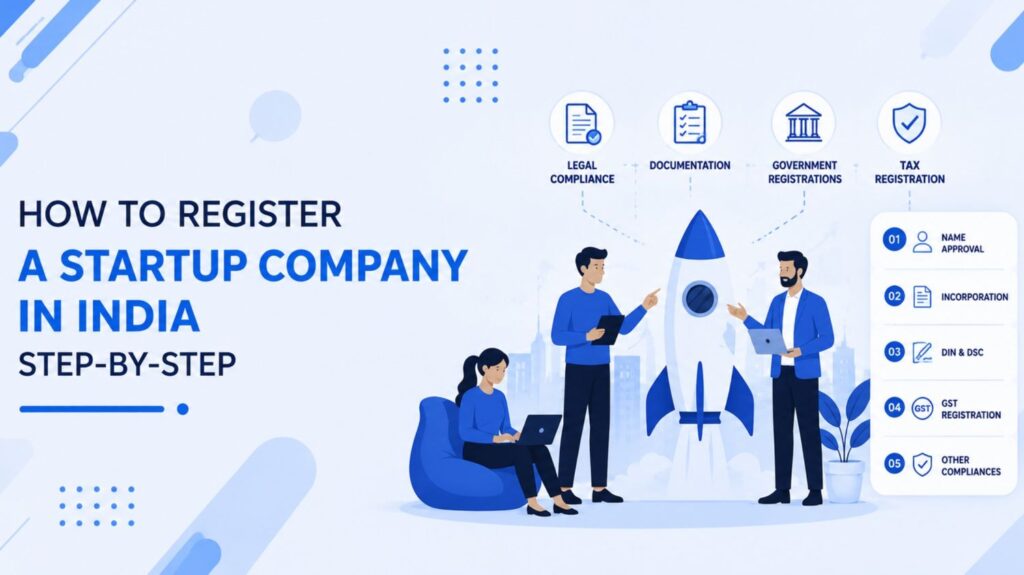
Starting a business in India has become easier than ever due to digital registration systems and government startup initiatives. According to the Department for Promotion of Industry and Internal Trade (DPIIT), India has over 1 lakh+ recognized startups, making India one of the fastest-growing startup ecosystems in the world. Entrepreneurs are actively choosing legal startup registration to build credibility, raise funding, and grow professionally.
Contact For: Startup Business Registration
SSFintax Advisor, a trusted CA firm in Delhi, helps startups with smooth and professional startup registration support. In this blog, we will explain the complete startup registration process in India step-by-step, including documents, business structures, benefits, and compliance requirements.
What is Startup Registration?
“Startup registration” means legally registering your business under an appropriate business structure, such as
- Private Limited Company
- LLP (Limited Liability Partnership)
- OPC (One Person Company)
- Partnership Firm
After company registration, eligible startups can also apply for DPIIT Startup Recognition under the Startup India initiative.
Why is Startup Registration Important?
Many entrepreneurs start businesses informally, but legal startup registration provides long-term business benefits such as:
- Legal business identity
- Better credibility with clients and investors
- Easy bank account opening
- GST and tax compliance
- Funding and investment opportunities
- Government startup scheme access
- Protection of brand and ownership structure
Today, investors and large companies usually prefer working with legally registered businesses instead of unregistered entities.
Step-by-Step Startup Registration Process in India
Step 1: Choose the Right Business Structure
The first step is selecting the correct business structure based on your goals, ownership, and scalability.
Common Startup Structures
Structure | Suitable For |
Private Limited Company | Startups seeking growth & funding |
LLP | Professional/service businesses |
OPC | Single-founder businesses |
Partnership Firm | Small traditional businesses |
Most scalable startups prefer a private limited company because it offers better investment and ownership flexibility.
Step 2: Obtain DSC (Digital Signature Certificate)
A digital signature certificate is required for online company registration filings.
It is used to:
- Sign incorporation forms digitally
- Verify MCA filings securely
Directors of the company usually require DSC.
Step 3: Apply for Director Identification Number (DIN)
Every director in a company must obtain:
DIN (Director Identification Number)
It is issued by the Ministry of Corporate Affairs and acts as the director’s official identification number.
Step 4: Reserve the Company Name
The startup must choose a unique company name.
The name:
- Should not match existing businesses
- Must comply with MCA naming guidelines
- Should reflect business activity professionally
Name approval is done through the MCA portal.
Official portal: MCA Portal
Step 5: Prepare Incorporation Documents
The following documents are generally required for startup registration:
For Directors
- PAN Card
- Aadhaar Card
- Passport-size photograph
- Mobile number & email ID
- Address proof
For Registered Office
- Electricity bill/rent agreement
- NOC from property owner
Step 6: File Company Incorporation Forms
After documentation, incorporation forms are filed online with MCA.
These forms include:
- Director details
- Shareholding pattern
- Registered office address
- Company objectives
Once approved, the company gets the following:
- Certificate of Incorporation (COI)
- CIN Number
- PAN & TAN
Step 7: Apply for Startup India Recognition (Optional but Important)
Eligible startups can apply for:
DPIIT Startup Recognition
under the Startup India scheme.
Benefits may include:
- Tax exemptions (eligible cases)
- Startup funding support
- Easier compliance
- Government scheme benefits
- Networking opportunities
Official portal: Startup India Portal
Step 8: Open Current Bank Account
After Company Registration:
A business current account is usually opened using the following:
- PAN
- COI
- GST certificate (if applicable)
- Board resolution
A dedicated business bank account is important for:
- Professional transactions
- Accounting records
- Compliance management
Step 9: Apply for GST Registration (If Required)
Businesses crossing turnover limits or providing taxable services may require the following:
GST Registration
GST registration helps startups:
- Issue GST invoices
- Claim Input Tax Credit
- Work with B2B clients
- Sell across India legally
Important Compliance After Startup Registration
After registration, startups must maintain the following:
- Accounting records
- ROC compliance
- GST filing
- Income tax filing
- TDS compliance (if applicable)
Proper bookkeeping and compliance help avoid penalties and improve business transparency.
Common Mistakes to Avoid During Startup Registration
- Choosing the wrong business structure
- Incorrect documentation
- Name rejection due to similarity
- Mixing personal and business finances
- Ignoring post-registration compliance
Professional guidance can help avoid these issues.
Why Professional Assistance Matters
Startup registration involves:
- Legal documentation
- MCA filings
- Tax compliance
- Government approvals
Working with professionals helps ensure the following:
- Faster registration
- Proper compliance
- Accurate documentation
- Long-term business setup support
How SSFintax Advisor Can Help
SSFintax Advisor provides professional assistance for the following:
- TDS Filing & Compliance, etc.
Their team helps startups and small businesses manage registrations and compliance professionally.
Final Thoughts
Startup registration is the first step toward building a professional and trusted business in India. As India’s startup ecosystem continues to grow rapidly, legally registering your startup helps improve business credibility, compliance, funding opportunities, and long-term growth. Whether you are starting a tech company, consultancy, e-commerce business, or service-based startup, proper company registration gives your business a strong legal identity in the market.
SSFintax Advisor, one of the trusted CA firms in Delhi, provides professional support for startup registration, company registration, GST registration & filing, accounting & bookkeeping, MSME registration, income tax filing, and other business compliance services to help startups grow smoothly and professionally.
Start Your Startup Registration Today with Professional Company Registration Support from SSFintax Advisor.
FAQs on Startup Registration in India
1. What is startup registration?
“Startup registration” means legally registering a business under structures like a private limited company, LLP, OPC, or partnership firm.
2. Is startup registration mandatory in India?
No, startup registration is not compulsory, but it helps with legal identity, funding, GST compliance, and business credibility.
3. Which is the best company structure for startups?
Most startups prefer a private limited company because it is better for funding, scalability, and investor trust.
4. How long does startup registration take in India?
Usually, startup registration takes around 7–15 working days, depending on documentation and approvals.
5. What documents are required for startup registration?
Basic documents include a PAN Card, Aadhaar Card, address proof, photographs, and registered office proof.
6. Can a single person register a startup?
Yes, a single founder can register a startup through OPC (one-person company) or proprietorship.
7. Is GST registration required for startups?
GST registration is required if the business crosses turnover limits or provides taxable services/products.
8. What is DPIIT Startup Recognition?
DPIIT Startup Recognition is government recognition under Startup India that provides benefits like schemes, funding support, and easier compliance.
9. Can freelancers register as startups?
Yes, freelancers and service providers can register their businesses legally under suitable business structures.
10. Why should startups choose professional registration support?
Professional support helps ensure proper documentation, faster registration, legal compliance, and smooth business setup.