
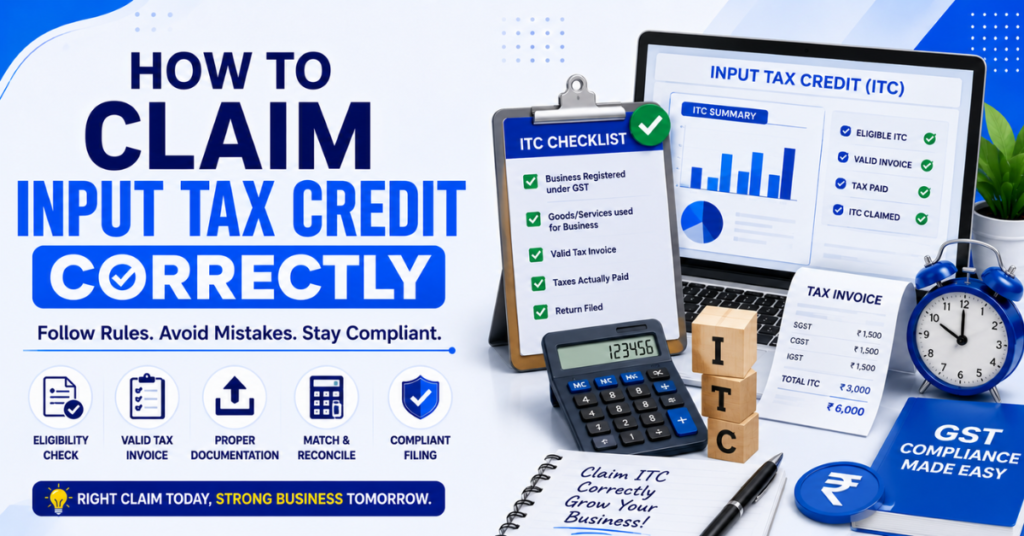
Input Tax Credit (ITC) is one of the most important benefits available to businesses registered under GST in India. It allows businesses to reduce their GST liability by claiming credit for the GST paid on eligible purchases and expenses.
However, ITC can only be claimed when all GST rules and conditions are properly followed. Incorrect ITC claims or failure to comply with GST requirements may result in notices, interest charges at 18% per annum, and penalties.
After completing GST registration, understanding the correct ITC claiming process becomes essential for every business. This guide explains the complete process of claiming ITC under GST in a simple and practical way.
Conditions Required for Claiming ITC Under GST
Before claiming Input Tax Credit in GSTR-3B, businesses must ensure that all conditions mentioned under Section 16(2) of the CGST Act, 2017, are fulfilled.
The basic conditions for claiming ITC are the following:
1. Valid Tax Invoice Availability
The buyer must have a proper tax invoice issued by a GST-registered supplier for the goods or services received.
2. Actual Receipt of Goods or Services
The goods or services mentioned in the invoice must have actually been received by the business.
3. Supplier Compliance
The supplier must have reported the invoice details and paid applicable GST to the government through their GST return filing.
4. Invoice Visibility in GSTR-2B
The invoice should appear in the buyer’s auto-generated GSTR-2B statement before claiming ITC.
If any of these conditions are not satisfied, the ITC claim may become ineligible.
Step-by-Step Process to Claim ITC Correctly Under GST
Step 1: Download and Check GSTR-2B
Businesses should download their GSTR-2B from the GST portal after the 14th of every month.
GSTR-2B is an auto-generated statement based on supplier invoices reported through GSTR-1. It helps businesses identify eligible ITCs available for a particular period.
Always verify GSTR-2B before claiming ITC in GSTR-3B.
Step 2: Reconcile Purchase Register With GSTR-2B
Compare your purchase register with the invoices available in GSTR-2B.
If an invoice is missing from GSTR-2B, ITC cannot generally be claimed even if:
- You have the physical invoice
- Payment has already been made to the supplier
In such cases, businesses should coordinate with suppliers to complete pending GST compliance.
Step 3: Identify Blocked ITC Under Section 17(5)
Certain expenses are restricted under GST and cannot be claimed as input tax credit.
Examples of blocked credits include:
- Food, beverages, and catering expenses
- Motor vehicles used for personal transportation (subject to conditions)
- Club membership expenses
- Certain insurance-related expenses
- Construction of immovable property for personal/business use where restricted
- Goods or services used for personal purposes
Businesses should review each expense before claiming ITC.
Step 4: Follow the 180-Day Payment Rule
As per GST rules, if payment to the supplier is not made within 180 days from the invoice date, the claimed ITC needs to be reversed along with applicable interest.
Once payment is made to the supplier, the ITC can be claimed again as per applicable rules.
Step 5: Reverse ITC for Exempt Supplies
If a business provides both taxable and exempt supplies, full ITC may not be available.
A proportionate reversal of ITC may be required according to Rule 42 of the CGST Rules.
Step 6: Claim ITC Within the Allowed Time Limit
ITC related to invoices of a financial year must be claimed within the time limit prescribed under Section 16(4) of the CGST Act.
Generally, ITC must be claimed by:
- 30th November of the following financial year, or
- Date of filing annual return (GSTR-9), whichever is earlier
After the deadline, missed ITC may not be available.
Step 7: Report ITC in GSTR-3B
Eligible ITC should be reported correctly in the following:
- Table 4(A) – Eligible ITC
- Table 4(B) – ITC Reversal (where applicable)
After reporting ITC, businesses should file GSTR-3B within the due date and pay the remaining GST liability.
How SSFintax Advisor Helps Businesses With GST & ITC Compliance
Managing ITC requires regular reconciliation, accurate accounting records, and continuous monitoring of GST updates. Many businesses find it challenging to manage compliance along with daily operations.
SSFintax Advisor provides professional assistance for the following:
GST Registration & Return Filing
Support for GST registration, monthly GSTR-1, GSTR-3B filing, annual returns, and ITC reconciliation.
Accounting & Bookkeeping Services
Maintaining accurate GST-compliant books, ledgers, and financial records for smooth compliance.
Company Registration Support
Assistance with company incorporation, documentation, DSC, DIN, and MCA-related processes.
MSME/Udyam Registration
Support for MSME registration and documentation requirements.
Income Tax Return Filing
ITR filing support for individuals, firms, LLPs, and companies.
ROC & Annual Compliance
Assistance with MCA filings and annual compliance requirements.
TDS Compliance Services
Support for TDS returns, Form 16/16A, and reconciliation.
From startups and traders to growing businesses, SSFintax Advisor helps simplify GST and tax compliance through reliable professional support.
Conclusion
Input tax credit under GST is not just a benefit but a compliance process that requires proper documentation and timely action.
Businesses should regularly check GSTR-2B, avoid claiming blocked credits, follow the 180-day payment rule, and maintain accurate records to maximize eligible ITC.
With proper GST compliance and reconciliation, businesses can reduce their tax burden and avoid unnecessary notices or penalties.
SSFintax Advisor provides professional assistance for GST registration, GST filing, ITC reconciliation, accounting, and complete business compliance solutions.
Frequently Asked Questions (FAQs) About GST Input Tax Credit (ITC)
1. Should ITC be claimed based on GSTR-2A or GSTR-2B?
ITC should be claimed based on GSTR-2B. GSTR-2B is a fixed monthly statement generated by the GST portal and helps businesses identify eligible ITC available for claiming.
2. Can I claim ITC if my supplier has not filed GSTR-1?
No. If the supplier has not reported the invoice through GSTR-1, the invoice may not appear in your GSTR-2B, and ITC cannot generally be claimed.
3. What happens if excess ITC is claimed?
If incorrect ITC is claimed, the GST department may issue a notice. The taxpayer may need to pay the reversal amount along with interest and applicable penalties under GST provisions.
4. Can ITC be claimed on the Reverse Charge Mechanism (RCM)?
Yes, ITC can be claimed on eligible RCM transactions. However, RCM tax must first be paid in cash, after which eligible ITC can be claimed.
5. What is the last date for claiming ITC for FY 2024-25?
ITC for FY 2024-25 must generally be claimed by 30th November 2025 or before filing the annual return, whichever is earlier.
6. Can composition scheme dealers claim ITC?
No. Businesses registered under the GST composition scheme cannot claim input tax credit.
7. What is the 180-day ITC reversal rule?
If payment to the supplier is not completed within 180 days from the invoice date, the ITC claimed on that invoice needs to be reversed along with applicable interest.
8. Is ITC available on health insurance expenses?
Generally, health insurance is considered a blocked credit under GST. However, exceptions may apply where insurance is mandatory under applicable laws.
9. Can ITC be claimed on machinery and capital goods?
Yes, ITC can be claimed on eligible capital goods used for business purposes. If used for both taxable and exempt supplies, reversal rules may apply.
10. How can ITC be claimed on imported goods?
ITC on imported goods can be claimed based on the Bill of Entry. IGST paid during customs clearance can be claimed through GST return filing after meeting applicable conditions.