
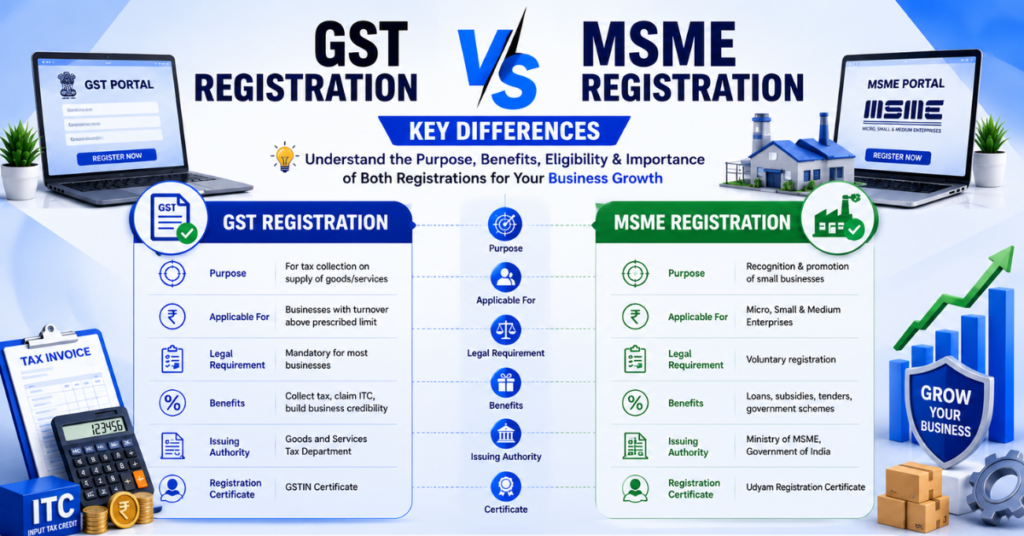
The difference between GST registration and MSME registration is explained here. Here, we highlight some key differences every business owner should be aware of between GST registration and MSME registration.
Click Here for MSME & GST Registration Online
Among the two registrations that crop up almost at the inception of business in India, one of the most important is GST registration, and the other is MSME (Udyam) registration. A lot of business owners mistakenly think that the two go hand in hand or that one can be replaced by the other. They don’t. They have very different functions, and knowing the difference helps you to ensure compliance from the start.
GST Registration – What Is It?
The Goods and Services Tax Act, 2017, obligates businesses with an annual turnover of over the prescribed threshold (currently ₹40 lakh for goods, ₹20 lakh for services, and ₹10 lakh for special category states) to register for GST. After getting registered, a business will get a 15-digit GSTIN, and it is required to collect the GST from the customers, submit regular returns, and pay the tax to the government.
Businesses that fall below the threshold will also have the option to register for e-GST online voluntarily to avail of input tax credit and to grow revenue from B2B transactions.
GST registration is a tax compliance requirement of the government—it is all about collecting and remitting an indirect tax.
What is MSME (Udyam) Registration?
MSME registration is actually the government certification under the MSME Development Act, 2006, and has been officially known as Udyam Registration since July 2020. It differentiates businesses in terms of investment in plant/machinery and annual turnover as Micro, Small, or Medium Enterprises (MSEs):
Category | Investment Limit | Turnover Limit |
Micro | Up to ₹1 crore | Up to ₹5 crore |
Small | Up to ₹10 crore | Up to ₹50 crore |
Medium | Up to ₹50 crore | Up to ₹250 crore |
The MSME registration is a benefit scheme with benefits such as government subsidies, priority sector loans, low interest rates, no delayed payments, and government tenders.
GST Registration vs MSME Registration: Difference between the two
Parameter | GST Registration | MSME/Udyam Registration |
Governing Law | CGST Act, 2017 | MSME Development Act, 2006 |
Purpose | Collecting taxes and complying with tax laws | Business gains and government assistance are provided. Support and benefits are received by the business and government. |
Mandatory? | Yes, above the threshold of turnover | No, fully voluntary |
Who Issues It | GSTN (GST Network) | Ministry of MSME |
Certificate | GSTIN (15-digit number) | Udyam Registration Number |
Return Filing | Yes — GSTR-1, GSTR-3B, etc. | There is no return filing requirement. |
Cost | Free (government portal) | Free (government portal) |
Renewal | Not required | Not required |
Benefit | The legal right to collect GST and claim ITC. | Subsidies, loans, and tender eligibility. |
Can You Have Both?
Yes, and you should because… A business may have both types of registrations at the same time and must at least have one of each. For instance, if a small manufacturer has a turnover of ₹3 crore or more, then he/she has to get registered under GST (where the turnover is above ₹40 lakh) and with Udyam registration (less than ₹5 crore) to avail a lot of benefits.
The two registrations are free, online, and independent of each other.
SSFintax Advisor can assist you in the following ways:
Registration and compliance can be a labor-intensive and tedious process. For all startups, entrepreneurs, and small businesses in India, SSFintax Advisor offers complete assistance.
Their services include:
- Select the appropriate business structure and register your startup in no time.
- Full MCA registration along with DSC, DIN, and an incorporation certificate for the company.
- GST Registration & Return Filing — From applying for GST registration online to monthly GSTR-1, GSTR-3B,,, and annual GSTR-9 filing
- Accounting & Bookkeeping Services — Books aligned to GST, ready for audits!
- Individuals/Companies/Partnerships/LLPs — Income Tax Return Filing
- Registering for MSME/Udyam Certificate— This is a fast process for obtaining the Udyam certificate, which unlocks various advantages and loans provided by the government.
- To prevent penalties, annual and event-based MCA filings are required for compliance with the term ROC compliance.
- Complete TDS return management & issuance of Form 16/16A — TDS Filing & Compliance
Whether it’s one registration or comprehensive business compliance support, SSFintax simplifies compliance, ensuring it’s accurate and cost-effective.
Conclusion
Both the GST and MSME registrations are valuable, but they both have different purposes. Enrollment is mandatory above a certain turnover limit. MSME registration is an optional benefit that unlocks government schemes, easy loans, and business opportunities.
Register for both if your business qualifies. They support one another and create a more solid and legit business base.
SSFintax Advisor is here to assist you if you need any professional guidance with GST registration, business registration (Udyam), or even any business compliance requirements.
Frequently Asked Questions (FAQs)
Q1. Is there any business that is not required to register for GST?
No. GST registration is only compulsory when a business’ turnover exceeds the applicable limit or it meets the compulsory registration criteria.
Q2. Do I need to register as MSME/Udyam?
No, the MSME/Udyam Registration is not mandatory but it facilitates businesses to benefit from the government schemes, subsidies, loans,,, etc.
Q3. Is it possible to register your business under GST as well as MSME?
Yes. GST Registration and MSME/Udyam Registration are two different registrations and can be done separately for a business.
Q4. Do you have to pay any amount for GST or MSME registration?
GST registration and Udyam registration are free on the government website.
Q5. Do MSMEs need to submit a GST return?
There is no “return filing” involved in MSME/Udyam registration. GST-registered businesses need to file applicable GST returns.
Q6. In what percentile range is an MSME medium enterprise’s maximum turnover?
A medium enterprise can have an annual turnover of up to ₹250 crore and an investment of up to ₹50 crore in plants and machinery/equipment.
Q7. Who can apply for Udyam Registration?
Yes. Udyam Registration can be done by both the manufacturers and service providers.
Q8. Which documents are necessary for online GST registration?
For GST registration, the following documents are required: PAN Card, Aadhaar Card, Proof of Business Address, Bank Details, and Business Registration Documents.
Q9. Are there any benefits of MSME registration for getting a bank loan?
Yes, MSME registration is beneficial for businesses to avail themselves of government schemes, priority sector lending, and credit benefits.
Q10. Is it possible to get GST and MSME registration by a sole proprietor?
Yes. A sole proprietor can apply for GST & MSME registration separately.