
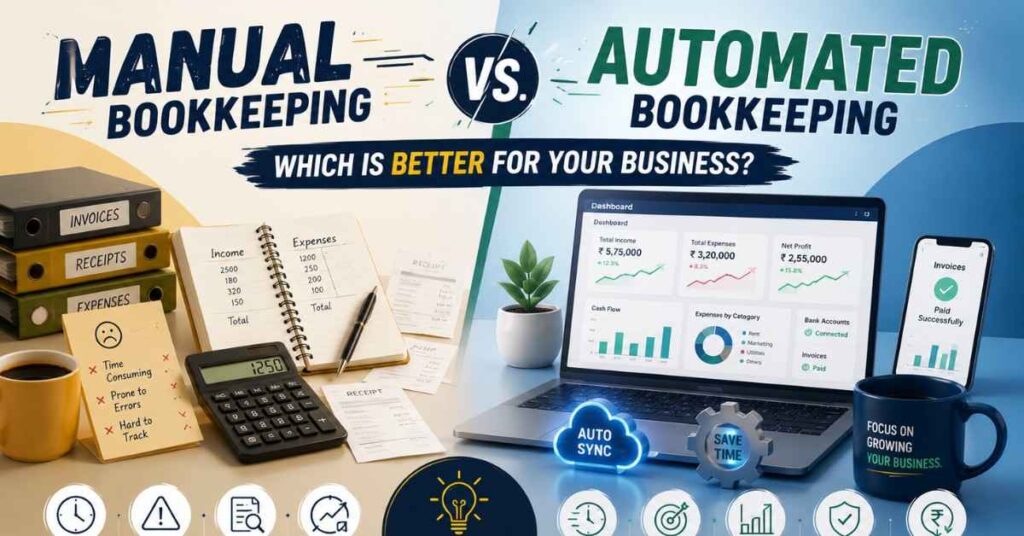
Bookkeeping is an essential part of managing any business. Accurate financial records help business owners understand income, expenses, cash flow, and overall financial performance. However, businesses today can choose between traditional manual bookkeeping and modern automated bookkeeping. So, which option is better?
The answer depends on the size of your business, the complexity of your transactions, your budget, and the level of accuracy and efficiency you need.
Need Outsourced Bookkeeping Services
What Is Manual Bookkeeping?
Manual bookkeeping involves recording financial transactions using spreadsheets, paper records, or other traditional methods. Every transaction, such as sales, purchases, expenses, and payments, is entered and organized manually.
Advantages of Manual Bookkeeping
- Simple to start: Small businesses with very few transactions may find manual records easy to maintain.
- Lower software costs: You may not need specialized accounting software.
- Direct control: Business owners can personally review and record every transaction.
- Useful for very small operations: Businesses with limited financial activity may manage basic records manually.
Disadvantages of Manual Bookkeeping
- Time-consuming: Entering transactions manually can take considerable time.
- Higher risk of errors: Typing, calculation, or data-entry mistakes can affect financial records.
- Difficult to scale: Managing hundreds or thousands of transactions manually becomes increasingly challenging.
- Limited reporting: Generating detailed financial reports can require additional manual work.
- Record management: Maintaining and organizing large volumes of documents can become difficult.
What Is Automated Bookkeeping?
Automated bookkeeping uses accounting software and digital tools to record, categorize, organize, and process financial information. Depending on the software and setup, some transactions can be imported automatically from connected bank accounts, invoices, or other financial systems.
Advantages of Automated Bookkeeping
- Saves time: Routine data entry and calculations can be reduced through automation.
- Improves efficiency: Financial information can be organized and accessed more quickly.
- Faster reporting: Accounting software can generate reports such as profit and loss statements and balance sheets.
- Better scalability: Automated systems are generally more practical as transaction volumes increase.
- Centralized records: Digital records can make financial information easier to organize and retrieve.
However, automation does not remove the need for professional review. Incorrect categorization, missing transactions, or poor software configuration can still result in inaccurate books.
Manual vs. Automated Bookkeeping: Which Should You Choose?
The right approach depends on your business needs.
Factor | Manual Bookkeeping | Automated Bookkeeping |
Time required | Higher | Generally lower |
Data-entry errors | Higher risk | Can be reduced |
Reporting | More manual work | Faster and easier |
Scalability | Limited | Better for growing businesses |
Initial setup | Simple | Requires software and setup |
Professional oversight | Recommended | Recommended |
For a very small business with limited transactions, manual bookkeeping may be sufficient. For growing businesses with regular transactions, automated bookkeeping can provide greater efficiency and easier financial management.
Should You Consider Outsourcing Bookkeeping?
Businesses that do not have the time or expertise to maintain their financial records may consider outsourced bookkeeping services. Outsourcing can provide access to professional bookkeeping support without requiring a full-time in-house employee.
Professional bookkeeping services can help businesses maintain organized records, reconcile accounts, track transactions, and prepare useful financial information for decision-making. The exact services provided depend on the accounting firm and the business’s requirements.
For businesses located in the capital, working with experienced bookkeeping services in Delhi can be a practical option when reliable financial record management is needed.
Choose the Right Bookkeeping Approach for Your Business
Manual bookkeeping can work for businesses with simple and limited transactions, but automation generally becomes more useful as a business grows. Regardless of the method, accurate records, regular reconciliation, proper documentation, and professional oversight remain important.
SSFintax Advisor, a CA firm in Delhi, can help businesses understand their bookkeeping requirements and choose an appropriate approach based on their financial activities and reporting needs. Professional guidance can help business owners maintain reliable financial records while focusing more time on running and growing their business.