
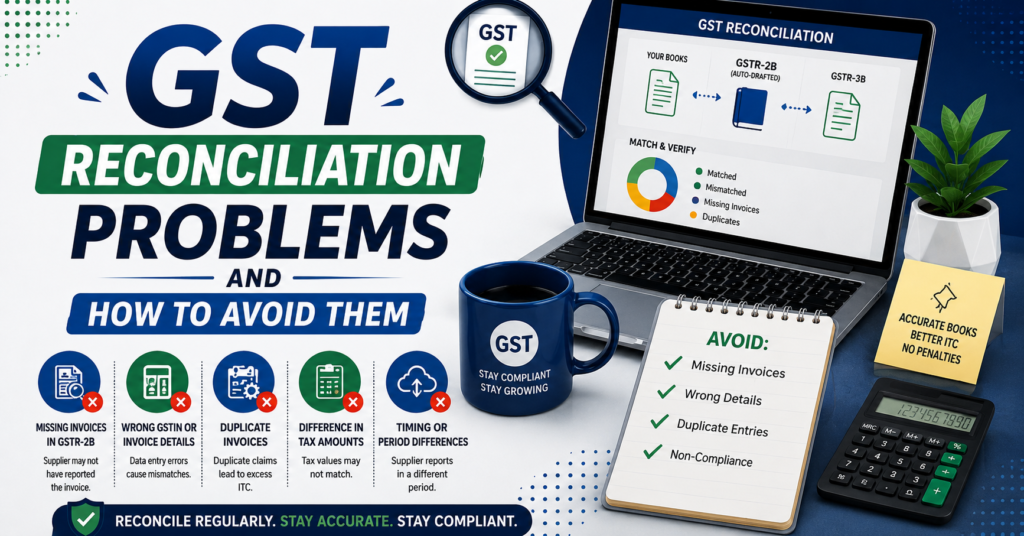
This article details some of the most frequently occurring GST reconciliation issues and offers guidance to minimize the chance of them.
GST reconciliation is a crucial aspect of keeping track of accurate tax records and claiming ITC. The businesses must compare the purchases made with the details available in the GST returns and GSTR-2B. As GSTR-2B is an auto-drafted document based on input reported by the supplier or other sources mentioned, discrepancies may happen in cases of mismatch or incorrect reporting of the invoice by the supplier or mismatch in GSTRs of the buyer.
Frequent reconciliation can minimize the chances of incorrect ITC claims and detect errors early for businesses.
Click Here For GST Registration & Return Filing
So, what is GST reconciliation?
The reconciliation of GST involves comparing the GST reports GSTRs in the GST portal and the GST details in the accounting books of the business. This is typically a validation of the purchase invoice, tax, GSTIN, invoice number, and ITC reflected in GSTR-2B.
The aim is to spot the differences and act as necessary before returns have been filed or accounts finalized.
Some typical GST reconciliation issues are listed below:
1. No invoices are appearing in GSTR-2B.
2. No invoices are appearing in GSTR-2B.
A common problem is that the purchase invoice may be debited to the company’s books and not be reflected in GSTR-2B. This can occur if the invoice is not reported properly by the supplier or if the return information hasn’t been reported.
How to avoid it:
- Compare purchase records with GSTR-2B periodically and discuss with suppliers about the delay in receipts when there is a delay.
2. Wrong GSTIN or Invoice Details
Either the supplier or a supplier might be reporting an incorrect GSTIN, invoice number, taxable value, or tax amount. A mismatch may occur during reconciliation if there is any data entry error, no matter how minor it may seem.
How to avoid it:
- Check the accuracy of the invoice before entering purchases and ask suppliers to correct the invoice if it is incorrect.
3. Duplicate Invoices
Accounting records can be duplicated, leading to businesses claiming more ITC than what is substantiated by their purchase records.
How to avoid it:
- Ensure that a systematic invoice numbering and verification process is implemented and have a check for duplicate invoices in monthly reconciliation.
4. Difference in Tax Amounts
The amount of GST recorded in books may be different from the amount reported by the supplier. These variances should be explored and not overlooked.
How to avoid it:
- Verify taxable value, CGST, SGST, IGST, and applicable cess of the invoice with the data shown on the portal.
5. Timing Differences
In some situations, an invoice may be entered in the books in one period, but it will be seen in GSTR-2B in a different period due to the period in which the supplier reported it. GSTR-2B is a static statement, which is based on data provided by the supplier and on specific suppliers’ sources for a particular period.
How to avoid it:
- Use a reconciliation tracker and keep track of invoice items that are pending or expected during the next periods.
How Businesses Can Improve GST Reconciliation
The reconciliation process should be done on a regular basis (monthly) rather than yearly. Record purchases properly, download GSTR-2B, compare, discuss with suppliers, and resolve any differences.
Professional GST accounting services can also aid in creating a standard reconciliation procedure and also keep better financial records.
If the business does not have its own accounting department, the outsourcing of the taxation services can provide professional assistance to verify with the GST, reconcile with it, and process the related taxes.
Conclusion
GST reconciliation assists businesses in ensuring that their books remain accurate, spot discrepancies, and make well-considered choices about ITC. An investigation of mismatches, not just any adjustments to recordkeeping, is important.
SSFintax Advisor, a CA firm in Delhi, can help businesses with their GST accounting, reconciliation, and taxation needs, providing reliable services. GST compliance can be made more organized, and discrepancies could be taken care of on time if reviews are done regularly for the professionals.
Note: GST rules & procedures are subject to change with notification, circulars, and updates in the portal. It is important for businesses to check what provisions apply to their situation.