
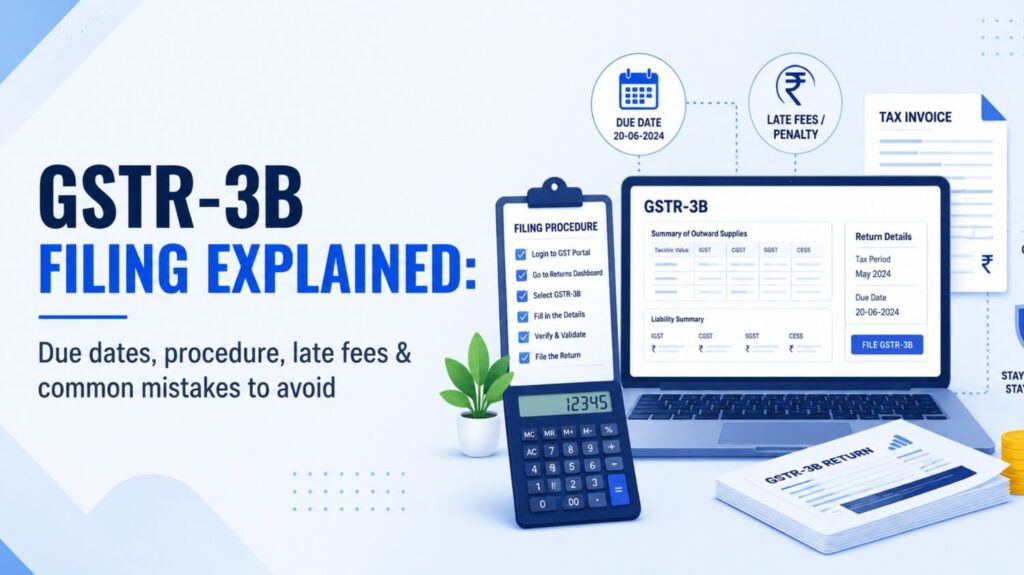
GSTR-3B is one of the most important GST return forms, which is to be filed by all the registered taxpayers of India. It’s a summary return with information regarding outward supplies, inward supplies, input tax credit (ITC), and tax liabilities for a particular tax period. Proper and timely filing of GSTR-3B is crucial for maintaining GST compliance and preventing penalties.
Click Here: Apply For GST Registration and Return Filing
Currently, taxpayers with a turnover of more than ₹5 crore are supposed to file monthly returns in GSTR-3B, while the eligible small taxpayers who are eligible for QRMP can file quarterly returns. The due date could be different as per state and taxpayer category. The timely filing is useful for businesses to keep proper financial records and for smooth ITC claims.
What is GSTR-3B?
GSTR-3B is a self-declared summary GST return, which all regular registered taxpayers are liable to file on a monthly/quarterly basis. This return will give details of taxable sale, purchase, output GST liability, and eligible input tax credit.
The GSTR-3B is a form to be used for paying the GST liabilities, as compared to GSTR-1, which was used primarily for outward supply details. All businesses have to compute the total amount of GST due, deduct the eligible input tax credit, and remit the balance amount before filing the return.
To tackle tax evasion and to ensure the accuracy of tax returns, the government has stepped up its efforts to monitor GST compliance over the last few years. Taxpayers who are continuously defaulting in GSTR-3B filing will also be barred from the generation of e-way bills and further e-way bill filing as per recent updates on GST. Therefore, compliance becomes crucial for companies of all sizes on a regular basis.
The process of filing GSTR-3B:
To file GSTR-3B first, it is necessary to gather all the sales and purchase records for the corresponding tax period. Prior to preparing returns, businesses have to ensure that all the information on the invoice, including the input tax credit and the tax amount, is correct.
The first step is to log in to the GST portal with valid login credentials and go to the section GSTR-3B and select the applicable return period. The taxpayer then needs to provide information on outward taxable supplies, inward supplies on which tax is to be paid by the buyer, exempt supplies, and eligible input tax credit.
Once the information is entered, businesses are required to total up the tax liability. The balance of the input tax credit in the electronic credit ledger can be used to adjust the GST payable. If there is any liability left to be paid, it must be paid using the electronic cash ledger prior to filing the return.
After making the tax payment, taxpayers are required to double-check all the entered data to prevent mismatches with GSTR-1 and their accounts. Once verified, the return can be filed with the help of a Digital Signature Certificate (DSC) or Electronic Verification Code (EVC).
The recent GST compliance reports reveal that invoice matching and reconciliation is one of the main areas on which the authorities are focusing. As per the recent reports of GST compliance, the authorities are keenly eyeing invoice matching and reconciliation of GSTR-1 and GSTR-3B. Any mismatches or mismatching returns will lead to GST notices, delayed input tax credit, and/or scrutiny of compliance.
Late fees and penalties are in effect. Late fees and penalties apply
Delay in filing GSTR-3B may lead to late fees, interest rates, and other compliance-related problems. Interest on the amount of tax not paid on time may be charged if the taxpayer does not pay his or her GST obligation. If the businesses delay the return filing again and again, they may also trigger restrictions in the GST operations and may receive further notices from the tax authorities.
Delayed filing can also have an effect on customers as the input tax credit claims are tied to the appropriate GST return filing. Hence, it is important for businesses to make sure that they are filing the taxes on time and reconciling them properly so that there is no hassle when it comes to legal and financial matters.
Common mistakes to avoid are: Common mistakes to avoid include:
Some of the common mistakes in filing GSTR-3B are incorrect claims for Input Tax credit, mismatching of invoice details, wrong calculations of GST, errors in GSTR-1 and GSTR-3B, etc.
One of the biggest errors is not reconciling books of accounts with the GST returns prior to filing. Apart from this, businesses are also seen to wait till the last possible date, which could cause technical problems on the GST portal during peak submission time.
By keeping accurate accounting records, checking invoices on a regular basis, and ensuring that tax amounts are calculated correctly, businesses can mitigate these common pitfalls and enhance their chances of compliance with the GST rules. Accurate bookkeeping, regular invoice checks, and diligent tax calculations can help prevent these errors and ensure better compliance with GST rules.
How SSFintax Advisor Can Help
We help businesses accurately and efficiently complete the GSTR-3B return with professional GST return filing services at SSFintax Advisor. Our experts help you with GST reconciliation, input tax credit verification, calculation of taxes, managing tax compliance, and timely submission of returns.
Ensuring compliance with the tax laws, avoiding penalties, and keeping up with the accurate maintenance of GST records, we assist businesses in minimizing compliance risk while also preventing penalties and ensuring smooth financial operations. With expert support from SSFintax Advisor, businesses can focus on growth while ensuring complete GST compliance and hassle-free return filing