
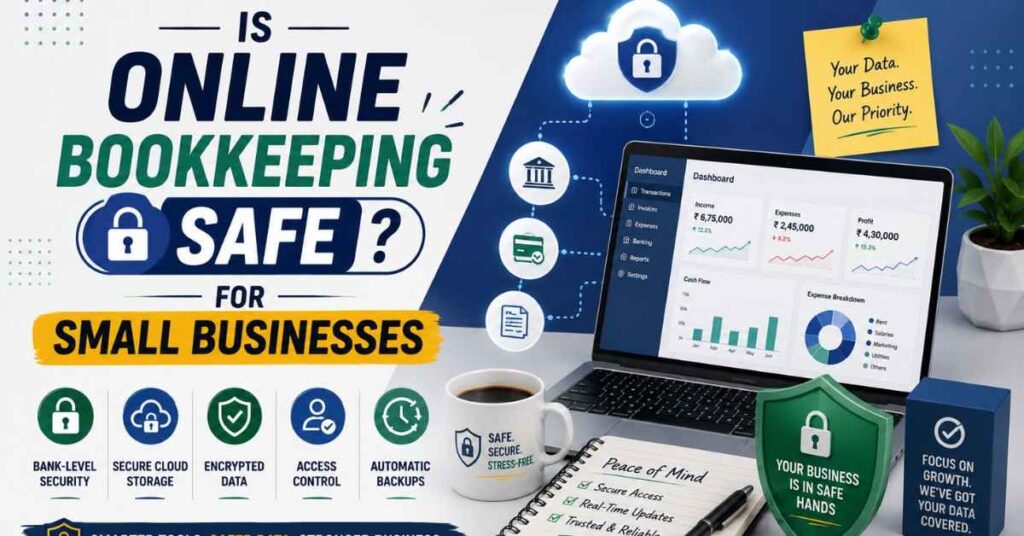
While maintaining accurate and secure finance records is crucial for any business, it is especially vital for small businesses. As technology advances and accounting software and electronic banking options proliferate in the “cloud,” many businesses are transitioning today to using online bookkeeping services to replace bookkeeping systems that rely entirely on a physical workspace or desktop software tools. However, one question that still needs to be answered for small businesses is, does online bookkeeping work?
Yes, if you use the appropriate systems, security protocols, and expert assistance. Before shifting to online financial records, however, business owners must be knowledgeable about the possible risks.
What Is Online Bookkeeping?
Online bookkeeping can be considered accounting or bookkeeping that uses the internet to keep business finance records. Depending on the system, businesses can record income, expenses, invoices, payments, bank transactions, etc., using a computer and/or mobile device.
Online bookkeeping may also make it simpler for business owners and bookkeepers to have access to the most up-to-date financial details, even if they’re not in the same location.
So, Is Online Bookkeeping Secure?
A good accounting software will have security features like multi-factor authentication, access control, backups, encrypting data, and password-protecting the software. But all digital systems are not 100% risk-free.
Online bookkeeping safety also relies upon the way that the company functions with the software.
Essentially, what you should be doing in relation to security is the following:
- Have strong and unique passwords for accounting accounts.
- Provide two or more forms of authentication if possible.
- Provide employees only with information they have need of.
- Ensure that accounting software, computers, and mobile devices continue to be updated.
- Steer clear of unsecured public Wi-Fi for financial areas.
- Periodically check account activity and user privileges.
- Maintain appropriate backups and financial records.
What Are Some Benefits of Online Bookkeeping for Small Businesses?
If managed effectively, online bookkeeping can offer a number of practical advantages.
These are the benefits of direct data access:
1. Remote Access
Records can be accessed remotely by business owners and qualified specialists, allowing them to work at various locations.
2. Better Collaboration
Online systems can enable business owners, bookkeepers, and accountants to have access to a precise set of financial data together.
3. Improved Efficiency
Automated transaction import, invoicing, and financial reporting can help minimize repetitive manual tasks.
4. Better Financial Visibility
Records can provide business owners with the information needed to know how money is moving in and out of the business and business performance.
When Is It the Best Time to Call in Professional Bookkeeping?
Online software cannot take the place of professional judgment. Accurate transaction classification, reconciling transactions, record maintenance, and proper financial reporting are still needed by businesses.
Bookkeeping services are essential for maintaining organized records and spotting bookkeeping issues before they turn into bigger challenges for businesses.
If you’re not solely relying on your in-house bookkeeping team, you can benefit from business bookkeeping services, which can mean that you have access to professional assistance.
Selecting a Trustworthy Bookkeeping Partner
In case you’re seeking to get bookkeeping in Delhi, you should use an expert organization that practices proper confidentiality, access-control measures, documentation, and data security.
A CA firm in Delhi, SSFintax Advisor, can help businesses with their bookkeeping and accounting needs in an organized and professional manner.
Before selecting a bookkeeping service, inquire about examples of:
- The measures taken to safeguard financial data.
- Measures taken to ensure the security of financial information.
- The purpose of access is to identify who can have access to your records.
- How frequently records are reviewed and audited/reconciled.
- Which computer accounting software do we use?
- The procedures used for managing documents and backups.
- The maintenance of confidentiality – how it is handled.
Final Thoughts
When companies have to rely on a bookkeeping service that operates online using reputable software, practices good security, and has a professional on-call bookkeeper, a small business can consider it a safe and efficient solution. Technologies are just one factor. Access management, accurate bookkeeping procedures, and responsible handling of financial information are all essential.
That’s when it pays to use secure online accounting software that offers professional assistance, which could prove more convenient to small businesses and ensure that their accounts are handled properly.