
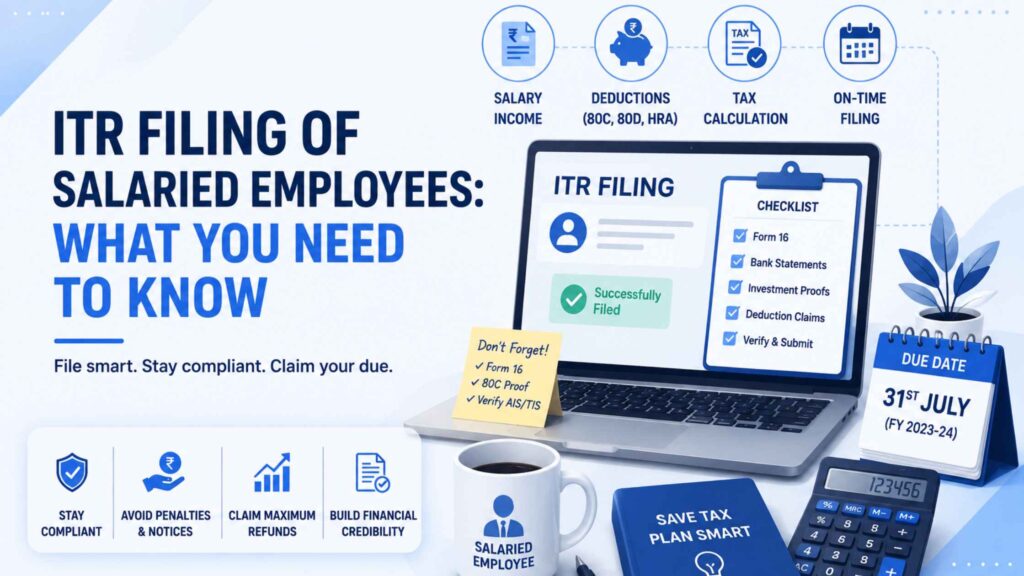
Should you be an employee with a salary in India, it is not only a legal requirement that you file your income tax return every year, but it is also one of the best financial habits you can develop. However, as per the Income Tax Department of India, there are quite a large number of salaried employees who either file wrongly or do not file at all. This guide encompasses all the information you must know prior to filing.
Visit Here For Income Tax Filing (ITR)
Who Doesn’t Have to File ITR as a Salaried Employee
Under the Income Tax Act, 1961, all those individuals whose gross total income surpasses that of the individuals referred to under the Medical Taxation Act, 1984. To file an ITR, 2.5 lakh per year will be required. In the case of senior citizens over 60 years, this limit is in Rs. There is 3 lakhs, and in the case of super senior citizens above 80 years, it is 3 lakhs. 5 lakhs.
Although you may have already deducted TDS by the employer on your salary, you still have to file your return. Deduction of TDS and filing of ITRs are two different things.
What ITR Form Do You Use
ITR-1 (Sahaj) is the form that applies to most salaried employees. This category is for those with a salary, one house property, and other sources such as interest income, as the total income is not more than Rs. 50 lakhs.
In case your income is more than Rs. Instead, you will have to fill in ITR-2 with 50 lakhs if you have capital gains.
Filing Documents You Need to File
To use any ITR filing service or to initiate online ITR filing, have the following documents available —
- Form 16 signed by your employer
- PAN card and Aadhaar card
- Interest certificates and bank account statements
- Section 80C, 80D deductions Investment proofs
- Home loan interest certificate if applicable
- Copy of ITR of previous year to be used as a reference
Important Deadlines to Keep in Mind
The deadline for the ITR filing of salaried employees without penalty is 31st July 2025, which is the last date of the financial year 2024-25 (assessment year 2025-26). Failure to meet this deadline will lead to a late filing fee of Rs. 5,000 under Section 234F—reduced to Rs. 1,000 in case the total income is less than Rs. 5 lakhs.
The Income Tax Department indicated that there were more than 7.28 crore ITRs, with salaried taxpayers having the largest proportion.
Why Online ITR Filing Makes More Sense Today
The online filing of income tax using the official portal incometax.gov.in has enabled the process to become much faster and convenient. You can pre-fill your data using Form 26AS and AIS, check your return using an Aadhaar OTP, and receive your refund directly into your bank account all without having to visit any office.
The refunds are currently managed within 10 to 15 working days of the filing and verifying.
Why Professional Assistance Remains a Matter
Although online ITR filing is available, any mistake in the selection of the form, wrong claim of the deductions, or mismatching TDS information can attract notices of the Income Tax Department. An experienced ITR filing service will make sure that your return has been filed correctly, all deductions have been made correctly, and your legal tax liability has been reduced.
Professional assistance is not a cost—it is a wise investment that will pay itself in tax savings and peace of mind it will bring with itself each and every year.
Ready to file your ITR correctly and on time? Get your income tax ITR filing online done by expert CAs at SSFintax Advisor—accurately, legally, and completely stress-free.