
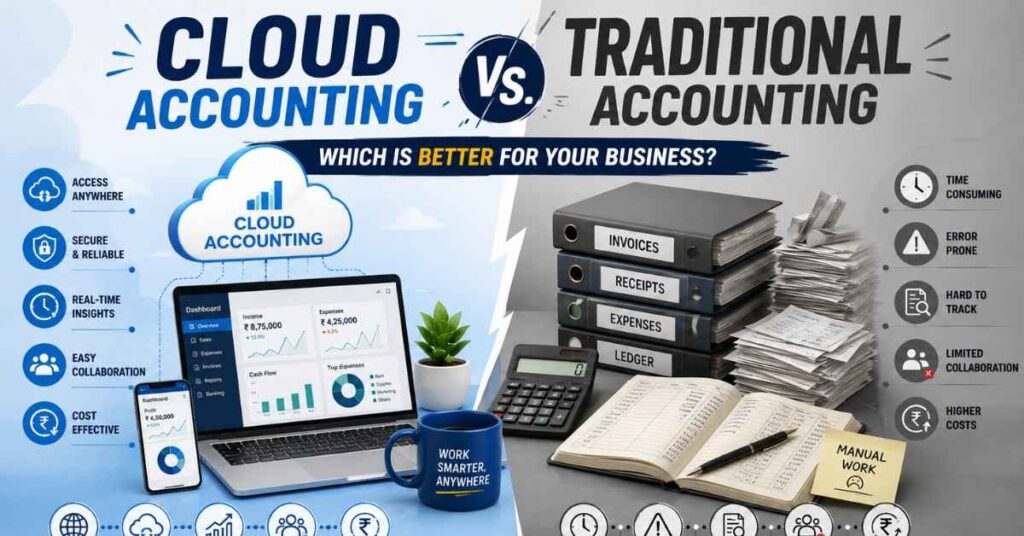
Accounting is an essential part of running any business. Accurate financial records help business owners understand their income, expenses, cash flow, taxes, and overall financial position. Today, businesses can choose between traditional accounting methods and cloud-based accounting solutions. But which option is better?
The right choice depends on your business size, accounting requirements, budget, and preference for technology. This guide explains the key differences so you can make an informed decision.
Need Monthly Accounting Services
What Is Cloud Accounting?
Cloud accounting uses internet-based accounting software to record, manage, and organize financial information. Instead of keeping accounting data only on a local computer, information is generally stored on secure remote servers and can be accessed through authorized devices.
Some common benefits include:
- Access to financial information from different locations.
- Easier collaboration between business owners and accounting professionals.
- Automated features for invoices, expense tracking, and financial reporting.
- Regular software updates without maintaining accounting software manually.
- Reduced dependence on paper-based records.
Cloud accounting can be particularly useful for businesses that have remote teams or work with external accounting professionals.
What Is Traditional Accounting?
Traditional accounting generally refers to accounting processes that rely more heavily on desktop-based software, locally stored records, spreadsheets, or paper documentation.
This approach can still work effectively for businesses with straightforward accounting requirements. It may also provide businesses with greater familiarity and control over locally maintained records.
However, traditional methods can become more time-consuming as a business grows, particularly when financial information needs to be shared between multiple people or locations.
Cloud Accounting vs. Traditional Accounting
Here are some important differences to consider:
1. Accessibility
Cloud accounting allows authorized users to access financial information through an internet connection. Traditional systems may require access to a particular computer or physical records.
2. Collaboration
Cloud-based systems can make collaboration between business owners, accountants, and employees easier. Traditional bookkeeping may require files or documents to be transferred manually.
3. Automation
Many cloud accounting platforms offer automated invoicing, transaction categorization, bank feeds, and reporting features. Traditional methods may involve more manual data entry.
4. Data Security
Reputable cloud accounting providers typically use security measures such as encryption, authentication, backups, and access controls. Businesses should still use strong passwords and appropriate user permissions. With traditional systems, businesses are generally responsible for their own local backups and security arrangements.
5. Scalability
Cloud accounting can be convenient when a growing business needs additional users, integrations, or financial management features. Traditional systems may require more manual processes as accounting needs become more complex.
Which Accounting Method Is Better?
There is no single solution that is best for every business. A small business with simple requirements may be comfortable with a traditional approach, while a growing company may benefit from the accessibility and automation offered by cloud accounting.
Before making a decision, consider:
- Business size and transaction volume.
- Number of people who need access to financial records.
- Reporting and invoicing requirements.
- Data security and backup procedures.
- Integration with other business tools.
- Overall accounting and technology costs.
Get Professional Accounting Support in Delhi
Choosing the right accounting system is only one part of effective financial management. Professional guidance can help businesses maintain accurate records, improve financial processes, and meet applicable compliance requirements.
SSFintax Advisor, a CA firm in Delhi, provides professional accounting services in Delhi, along with accounting services designed to support businesses with their financial management needs. Businesses can also consider outsourced accounting services when they want professional accounting support without maintaining a complete in-house accounting team.
Final Thoughts
Cloud accounting offers accessibility, collaboration, automation, and scalability, while traditional accounting can remain suitable for businesses with simpler requirements and established processes. The best choice depends on your individual business needs.
Whichever method you choose, maintaining accurate, timely, and well-organized financial records should remain a priority. Good accounting is not simply about recording transactions—it provides the financial information businesses need to make better decisions and plan for sustainable growth.