
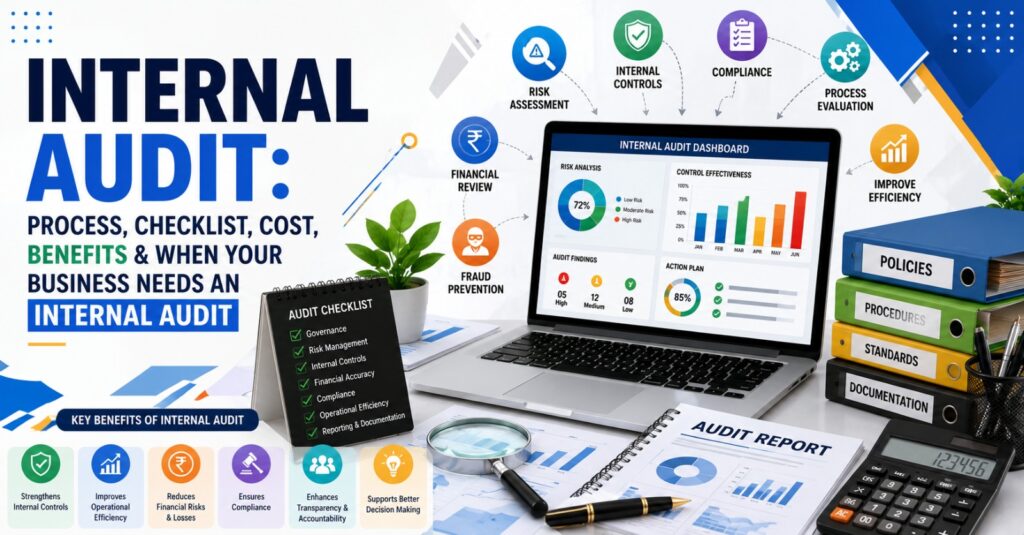
There is more to running a business than balancing the books and reporting to the revenue authorities. The more successful a business becomes, the more transactions, staff, suppliers, merchandise, and obligations a company has, all of which entail compliance rules. The more successful a business gets, the more transactions, employees, vendors, inventory, and compliance requirements a business will possess. Even the best managed companies can get account balancing wrong, approve unnecessary spending, lose items, have bad processes, or fail to comply with requirements, among other common problems, if they do not have adequate controls.
Talk to an SSFintax advisor to hire top-notch internal audit services and discuss your business audit needs.
This is where an internal audit can come in handy. Internal audit is a systematic examination of the internal processes, internal controls, risks, and operations of the business. It brings clarity to management on the areas of issues and how it can be done to improve the business operation.
Introduction: What is an Internal Audit?
Internal audit is independent and objective judgement of a business’s processes and controls, its risks, and its operations. It isn’t just for the fact that the accounts are accurate. It also examines the effectiveness of the control of key business processes and the identification and effectiveness of identified risks.
Internal audit is more a management and governance tool as opposed to a statutory audit, which is prescribed by law in certain entities. Under Section 138 of the Companies Act, 2013, and the rules set within, there are various kinds of companies that are mandated to have an internal auditor.
An internal audit, depending on the extent, can include controls and oversight of accounting, sales and purchases, banking transactions, inventory, payroll, expenses, GST compliance, vendor management, IT controls, approvals, and reporting to management.
When Does a Business Need an Internal Audit?
Internal audit may be beneficial where business activity is expanding or if management requires more transparency in its financial and operational activities.
An internal audit may be conducted in some of the following circumstances:
- Frequent errors in accounting or reconciling transactions.
- Poor approvals/authorizations/oversight
- Errors and shortages of inventory or losses of inventory items
- A company that operates several branches or locations. A business establishment with several outlets or locations.
- High transaction volumes
- Worry about unnecessary spending or charges.
- Loss of compliance in processes.
- Designed and executed more effective financial monitoring. Strengthened financial controls.
- Expansion or restructuring of the business.
- Internal audit requirements that are otherwise required under law
This will be decided based on the risks, structure, and size of the business.
Internal Audit Process: Step by Step
A good internal audit tends to have a structured methodology. This will depend on the scope of the engagement and the nature.
1. Understanding the Business
The internal auditors gain the knowledge of the business model, operations, accounting system, organizational structure of the business, and their major risks.
To outline the scope of the audit.
In the determination of the scope, management’s objectives and areas to be audited are taken into consideration. Can contain finance, procurement, sales, inventory, payroll, compliance, or any other business tasks involved in.
3. Risk Assessment and Planning
The auditor identifies key areas of risk and develops an audit plan. This will make sure that time and resources are spent in the right place.
4. Reviewing Internal Controls
The auditor makes an assessment on whether relevant controls are properly designed, communicating, and functioning accordingly. Internal controls audits can include reviews of approvals, reconciliations, segregation of duties, documentation, and other control procedures.
Testing and Gathering Evidence. Testing and Gathering Evidence.
Relevant transactions, documents, records, and processes are reviewed and tested. Appropriate evidence is maintained to support the audit observations.
6. Identifying Gaps
The auditor records any control deficiencies or efficiencies, compliance issues, and other related observations that occur during the audit.
7 Pre-Dispositions: Preparing the Audit Report
The results are delivered to the management via an audit report. The report may contain key observations made, implications, and recommendations for improvements.
8. Follow-Up
Follow-up verifies that management has taken the necessary correct steps for the agreed corrective actions. This makes the audit more beneficial to be performed and not even done once again.
Internal Audit Checklist: What Does an Auditor Check?
There’s no 101% rule as far as a checklist; this doesn’t work for everyone. The scope and nature of the engagement dictate the areas that would be reviewed.
Financial Controls
- Bank reconciliations
- Cash transactions
- The flexibility with which the costs of equipment and materials can be met.
- Expense approvals
- Journal entries
- Financial reporting
Sales and Purchases
- Sales Invoices and Purchase Invoices.
- Vendor approvals
- Customer balances
- Discounts and credit notes
- Procurement procedures
Inventory
- Stock records
- Physical inventory
- Inventory movement
- Obsolete or damaged stocks
- Stock reconciliation
Compliance and Payroll
- GST records and returns
- TDS-related procedures
- Licenses and registrations
- Compliance records
- Salary processing
- Employee reimbursements
- Records showing attendance and leave. Records of attendance and leave.
The internal audit consultants can concentrate on the areas that are most relevant to the business, as this is possible thanks to the use of a customized checklist.
What is needed to submit to an internal audit?
The documents needed are based on the kind of audit and might not be the same from one scope to another. The recorded documents that are typically requested are the trial balance, general ledger, financial statements, bank statements, sales and purchase registers, invoices, inventory records, GST and other compliance records, payroll records, vendor and customer ledgers, fixed asset registers, internal policies, and MIS reports.
Further documents may be requested where relevant to the risks under review or the processes.
Internal Audit Cost
Internal audit services do not have a set price. The cost depends on the following: size of business, number of transactions, number of locations, complexity of operations, size of the audit, number of processes being audited, frequency of audits, and resources needed.
For one to complete a selected process audit, they will typically need a different amount of time and resources than if they are asked to do a comprehensive audit of multiple business functions.
Benefits of Internal Audit
If planned well, an internal audit can assist a business to:
- Strengthen internal controls.
- Determine the financial and operational risk(s).
- Identify control deficiencies and irregularities
- Improve inventory management.
- Strengthen compliance processes.
- Improve management reporting.
- Reduce process inefficiencies.
- Improve accountability.
- Help businesses make better decisions. Facilitate better business decisions.
Corporate internal audit can then prove beneficial to entities at various stages of growth, especially when the number of transactions, business operations, and responsibilities has increased.
Helps companies with internal audit tasks by SSFintax Advisor.
SSFintax Advisor is a CA firm that offers professional internal audit services to businesses in need of assistance in areas like internal controls, process review, identification of risk, and compliance.
It is possible to tailor the audit approach to the characteristics of the business, including size, operation, risk, and requirements. In determining the scope of the audit, SSFintax Advisor can help guide businesses to identifying the records to be reviewed and any gaps that exist in their control and monitoring.
Besides internal audits, SSFintax Advisor offers accounting and bookkeeping solutions, GST registration and filing help, ITR solutions, and company registration professional solutions.
Depending on the engagement, businesses may also be interested in the risk advisory services to gain insight and deal with the relevant risks in business and controls.
FAQs
1. What is the main purpose of an internal audit?
An internal audit’s primary objective is to assess relevant business processes, controls, and risks and to offer management observations and suggestions for improvement.
2. Is internal audit compulsory for all the companies in India?
NO: Internal audit is not required for all companies. The Companies Act 2013, section 138, and the rules prescribe an internal audit framework to be followed for certain classes of companies.
3. When to have an internal audit?
The frequency is dependent on the risk of the enterprise, the scope, and the requirements of the audit. Internal audits can take place on a periodic basis in accordance with management’s needs and the framework.
4. How does internal audit differ from statutory audit?
The internal audit function is primarily focused on the internal control, the risk, and the processes and operations for management and governance. A statutory audit is done because of the requirements of applicable legislation and delivers an independent audit opinion in accordance with the relevant legislation.
5. Is an internal audit available with SSFintax Advisor?
Yes. SSFintax Advisor offers internal audit services customized for businesses’ needs. The scope could involve auditing the processes and controls that are relevant and finding any gaps and recommending them.
6. Does SSFintax Advisor support accounting and GST incorporation too?
Yes. Apart from internal audit, SSFintax Advisor also offers accounting and bookkeeping services, supports GST registration and filing, ITR services, and professional services related to company registration services.
7. What sort of businesses are there that can benefit from internal audit services?
An internal audit that is justice-sized and surface-appropriate could profit developing businesses, any company with numerous operations, businesses with a high volume of movements, businesses with several places, and businesses wanting to enhance their internal management procedures.