
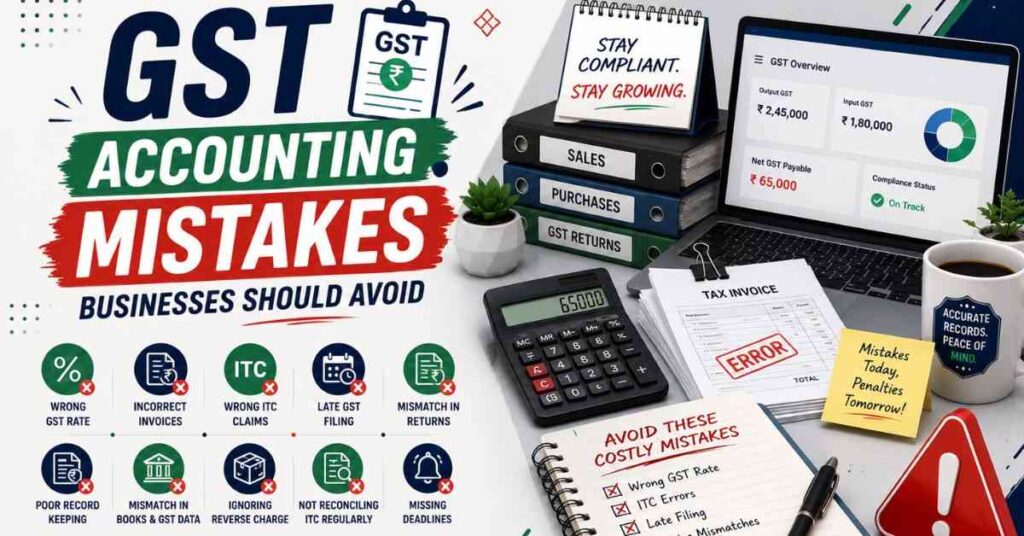
Businesses should avoid these common GST accounting errors.
Compliance with GST is one of the vital aspects in the running of any business in India. Accurate accounting and timely reconciliation enable businesses to report the correct tax liability, claim the eligible Input Tax Credit (ITC), and ensure proper financial record-keeping. Mismatches, increased compliance burden, or unnecessary tax costs can result from small accounting errors.
Let’s look at some of the common GST accounting pitfalls that businesses need to avoid.
Click Here for Reliable GST Accounting Services
1. Incorrect GST Classification
A frequent error is that the wrong GST rate or classification is applied to goods/services. All businesses need to ensure that they check the HSN or SAC and the applicable GST rate before issuing an invoice. Each of the GST rates may differ depending on the nature and classification of the supply, and assumptions shall be avoided.
2. Missing or Late ITC Claims
Businesses should not be permitted to simply rely on their purchase records for claiming ITC. The GSTN provides guidance to taxpayers to compare the GSTR-2B with their accounts and ensure that the credit is not availed twice.
Conducting regular reconciliation can help prevent missing invoices, duplicate entries, supplier reporting differences, and other inconsistencies from occurring prior to returns.
3. Errors in GST Invoices
Issues with the GSTIN, invoice number, taxable values, tax amounts, and other information on the invoice can cause compliance issues. Businesses need to check the details on the invoice thoroughly before paying it out.
Businesses must also ensure that the information required is properly entered and that the e-invoicing requirements are adhered to when e-invoicing is required. The guidance on official e-invoicing emphasizes the need for invoice data validation.
4. Poor Record Keeping
GST-registered businesses are supposed to keep true and correct books of accounts, which include inward supplies, outward supplies, stock, ITC availed, output tax payable, output tax paid, etc.
Incomplete and disorganized records can make GST reconciliation and compliance a lot more challenging.
5. Ignoring Reconciliation Differences
Any discrepancies between accounting records and GST records should not be overlooked. Where mismatches are found, businesses need to examine the reasons for them and make the necessary corrections or pass on these issues to the next person or place.
6. Not Updating on Changes to the GST
Compliance requirements, such as the rules, procedures, return requirements, and technology-related compliance requirements for GST, may change. It is important for businesses to check for official updates on GST regularly and keep their accounting systems updated accordingly.
Professional GST Support – How It Can Help?
Accurate GST records involve regular tracking of invoices, purchases, sales, ITC, reconciliations, and compliance. Professional assistance can assist businesses in setting up more appropriate accounting controls and detecting errors before they turn into bigger issues.
SSFintax Advisor is a CA firm from Delhi, providing outsourced taxation services to businesses. Businesses can benefit from professional advice, especially when they wish to ensure their records are kept in order and their GST compliance procedures are tightened up.
Final Thoughts
GST accounting is not a task or process that is last-minute compliance. By keeping accurate records, verifying invoices regularly, reconciling ITC, and being aware of their needs, businesses can minimize unnecessary mistakes and ensure better financial management.
If your business doesn’t have a dedicated accounting team, using experienced experts can offer you structured assistance and maintain your GST accounting more systematically and dependably.