
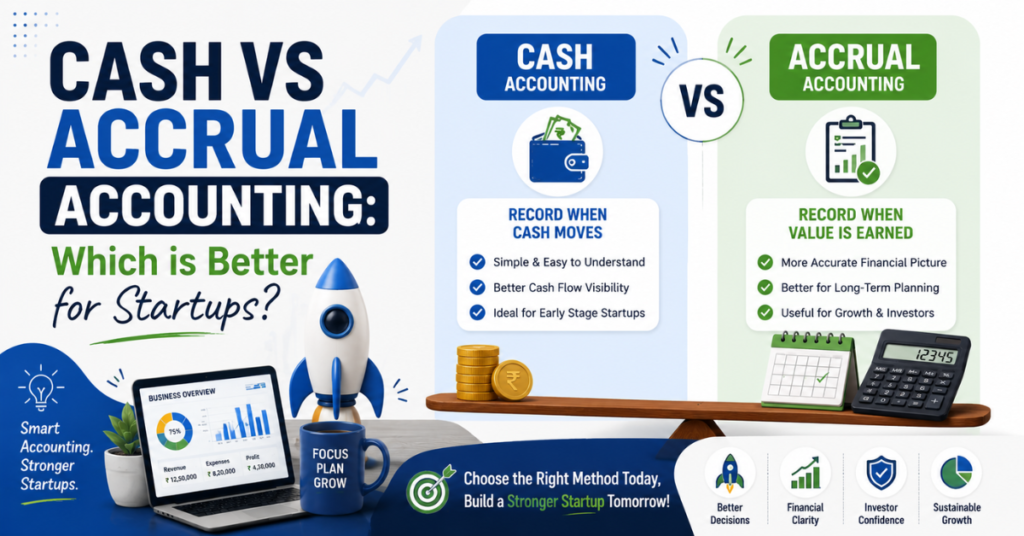
When you’re starting your business, there are numerous things you must consider—and one of those is the accounting method you’ll use. Two of the most popular accounting practices used by startups are cash accounting and accrual accounting. Knowing the difference between these methods will allow the founders to make better financial decisions and keep accurate records.
Click Here For Outsourced Bookkeeping and Accounting Services
What is the meaning of cash accounting?
Under cash accounting, income and expenses are only booked when cash is received or paid.
For instance, if your startup issues an invoice on June 1st but receives it on July 1st, then you’ll report income on July 1st. Expenses are also debited when they are paid and not when they are incurred.
Advantages of Cash Accounting
- Simple to use and keep up to date.
- Gives a true view of the available cash.
- Best for small businesses with a low volume of transactions.
- Lower bookkeeping complexity.
Cash accounting has drawbacks. There are disadvantages of cash accounting.
- Fails to demonstrate future obligations and/or due payments.
- Can give an incomplete view of business performance.
- Not as effective for startups looking for investors and financing.
What is accrual accounting?
Accrual accounting involves counting income and expenses when they are earned or incurred, not when cash is received or paid.
For instance, if your startup finishes a project in June and issues an invoice but the payment isn’t received until December, the revenue is recognized in June and not in December.
Pros of Accrual Accounting: Benefits of Accrual Accounting:
- Gives a more realistic view of financial results.
- Assists in the monitoring of accounts payable and receivable.
- Loved by investors, lenders, and financial institutions.
- Enables improved financial planning and forecasting.
The drawbacks to accrual accounting are the following:
- More complex than cash accounting.
- Must maintain appropriate books and records.
- May be able to show profits when cash has not been collected.
Cash Accounting and Accrual Accounting.
Feature | Cash Accounting | Accrual Accounting |
Revenue Recognition | Upon receipt of cash. On receipt of cash. | If the revenue is received. |
Expense Recognition | When payment is made | As soon as an expense is made. At the time of an expense. |
Complexity | Simple | More Advanced |
Financial Accuracy | Moderate | High |
Investor Readiness | Limited | Strong |
Growth Suitability | Small startups | Growing startups |
Which option is better for startups?
It all depends on the stage of your startup.
For new businesses that have lower numbers of transactions and a need for a simpler system, cash accounting might work for the beginning. When your business grows, hires workers, does business with vendors or applies for financing, accrual accounting is a more suitable option.
Accrual accounting is most common with most investors and financial professionals, since it gives a fuller picture of a company’s financial health. It gives the founders a more precise picture of business performance, obligations, and profitability.
Final Thoughts
A correct accounting approach is essential for the success of the startup. For long-term growth and more accurate financial information, accrual accounting is a better choice, but cash accounting is simpler.
We at SSFintax Advisor provide all the necessary assistance needed to build a robust accounting framework, accounting records, and manage compliance requirements for your startup while helping you make informed financial decisions. From startups to scaling, our accounting team can assist you in making the best decisions for your business’s sustainable growth.
Looking for Accounting and Bookkeeping Services for your startup? Call SSFintax Advisor today and put your business’s finances on a solid foundation.
Frequently Asked Questions (FAQs)
Q1. The primary difference between cash and accrual accounting is:
Cash accounting records when cash is received or paid and accrual accounting records when money is earned or incurred.
Q2. Which accounting method is best suited for startups?
The cash accounting is much simpler to follow and bookkeep; therefore, it’s generally easier.
Q3. What are the advantages of accrual accounting to investors?
Because accrual accounting offers a more precise view of a startup’s financial performance and obligations, it is the preferred method of accounting for investors.
Q4. Can a startup elect to change to accrual accounting after the initial start-up?
Yes, as a startup grows and its financial reporting becomes more complex, the accrual accounting method can be used.
Q5. Suppose that cash accounting is appropriate for funded startups?
For most startups, it makes more sense to use an accrual accounting system since investors need to have detailed financial reporting.
Q6. Does accrual accounting aid in financial planning?
Yes, accrual accounting can aid startups in their cash flow forecasting and revenue and expense prediction.
Q7. What is better: cash flow or accrual accounting?
Cash accounting offers a better understanding of the cash available in the business at a particular moment.
Q8. Yes, professional bookkeeping for accrual accounting is required for startup businesses.
Indeed, proper bookkeeping and professional financial management are essential and are a part of accrual accounting.
Q9. What is the benefit of accrual accounting when fundraising?
Accrual accounting gives investors and lenders information that is useful for use in their due diligence.
Q10. What accounting can be provided by SSFintax Advisor for Startups?
SSFintax Advisor is designed to assist startups in bookkeeping, accounting implementation, financial reporting, compliance management, and financial advice for growth.