
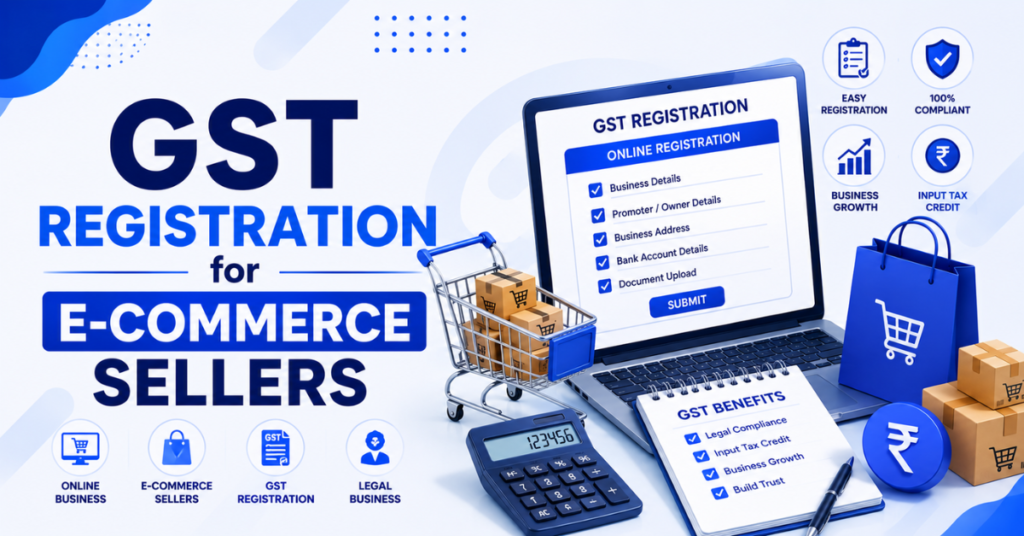
Internet sales, such as those on Amazon, Flipkart, Myntra, and Meesho and other websites, are one of the fastest-growing trends in India. But, before entering online sales, it is crucial to understand the requirements of GST compliance.
Click Here: Apply For GST Number
Online GST registration is not only a compliance criterion, but for most e-commerce sellers, it is a necessity to sell through e-commerce marketplaces legally. Non-compliance with GST guidelines may result in the restriction of the account, compliance notices, and disruptions to the business.
Helping the entrepreneurs & startups, SSFintax Advisor is a reliable CA firm in Delhi, India, to complete the GST registration compliance process in an efficient manner while also complying with the recent changes in the GST laws.
This guide covers the requirements, eligibility conditions, documents needed, and the procedure for registering for GST in India as well as compliance obligations for e-commerce businesses.
For the e-commerce seller, comprehending GST is crucial.
Goods and Services Tax (GST) is an indirect tax on the supply of goods and services in India.
An e-commerce seller means any person, proprietorship, partnership, LLP, company, or any other entity engaged in selling any product or goods using
- Amazon
- Flipkart
- Meesho
- Myntra
- JioMart
- Etsy
- Shopify stores
- Independent e-commerce websites
Online sellers have to comply with the GST rules and regulations, which are different from many other businesses that are not online.
Do e-commerce sellers have to do GST registration?
GST Registration Requirement Under GST Law
As per the existing provisions of the Goods and Services Tax, any person providing goods through an e-commerce operator, who is required to collect Tax Collected at Source (TCS), will generally have to register for GST irrespective of the turnover limit.
This is because numerous vendors doing business on e-commerce platforms are mandatorily liable to register under the Goods and Services Tax (GST) even when their turnover is below prescribed normal limits for certain offline businesses.
But GST rules come with periodical changes, and there are exceptions. Sellers need to consider what their actual business model is before moving forward.
Why do e-commerce platforms require GST registration?
Why do e-commerce platforms ask for GST registration?
Most e-commerce platforms ask for GST information since
- Eligible sellers are responsible for complying with the Goods & Services Tax.
- Platforms capture and provide transaction information.
- Compliance to TCS applies.
- Proper tax invoicing is required.
If there is no valid GST information, certain categories of products may be restricted from onboarding or selling.
GST registration for e-commerce sellers offers several advantages.
GST registration benefits for e-commerce sellers include the following.
Legal Compliance
GST registration enables the seller to meet the requirements of Indian tax laws and helps them prevent the problems related to compliance.
Input Tax Credit (ITC)
Under the provisions and conditions of the Goods and Services Tax (GST), registered businesses can avail of eligible input tax credit for business purchases.
Examples include:
- Packaging materials
- Office expenses
- Professional services
- Business equipment
- Logistics-related expenses
Business Credibility
Being a registered GST business will help you build credibility with the following:
- Customers
- Vendors
- Online marketplaces
- Financial institutions
Expansion Opportunities
Businesses that are registered for GST prefer to do business with large marketplaces, suppliers, and B2B buyers.
The following documents are necessary for online GST registration.
The following documents are required for online GST registration.
Documentation will vary depending on the nature of the business.
Typically requested documents are:
For Proprietorship Firms
- PAN Card of proprietor
- Aadhaar Card
- Passport-size photograph
- Business address proof
- Bank account details
For Partnership Firms
- PAN of firm
- Partnership deed
- Partner identity proofs
- Address proof
- Bank details
For Companies and LLPs
- PAN of company/LLP
- Certificate of Incorporation
- Authorized signatory details
- Address proof
- Bank account information
More papers may be needed based on the type of business and the requirements of the GST department.
How to Apply for GST Registration Online
Step 2: Clean up the property.
Have business or identity documents ready before starting the application.
Step 2: Fill out Online Application
GST registration can be done via the official GST portal.
Step 3: Verification Process
The submitted information and supporting documents are checked by the GST department.
Step 4: GSTIN Allotment
If the verification is successful, a GST Identification Number (GSTIN) will be issued.
Businesses can then legally engage in GST-compliant transactions.
GST Compliance Requirements for Ecommerce Sellers are the main points that you should note.
Getting GST registration is just the first step.
GST Return Filing
The registered sellers are required to submit the relevant GST returns on time.
Tax Invoice Compliance
If applicable, businesses need to provide GST-compliant invoices.
Record Maintenance
Proper records of:
- Sales
- Purchases
- Input tax credit
- Tax payments
- Returns filed
should be maintained.
Reconciliation of Transactions
Regular reconciliation is essential for e-commerce sellers:
- Marketplace reports
- GST returns
- TCS statements
- Sales records
To prevent mismatches in compliance.
Mistakes are the things that every E-commerce seller should avoid.
Delaying GST Registration
Many sellers start selling without being aware of the requirements of GST so that they face compliance problems later.
Incorrect Business Information
The registration may be delayed if there are any inaccuracies in the information provided regarding the PAN, address, or business information.
Ignoring Return Filing
Failure to file required returns can lead to notice and penalties for not getting GST registration.
Improper Record Keeping
Lack of documentation can lead to problems when reconciling and auditing.
Online vs Offline GST Registration
In the present times, the registration of GST in India is done online.
Benefits include:
- Faster processing
- Paperless application
- Easy document submission
- Online status tracking
- Improved transparency
This now facilitates businesses applying for the online GST registration from anywhere in India.
What is the optimum time to obtain GST registration?
GST should be taken into account by e-commerce sellers before putting the products in online marketplaces.
Early registration helps:
- Prevent onboarding delays
- Avoid compliance issues
- Facilitate seamless business processes.
- Support streamlined business functions.
- Enhance the marketplace procedure of approvals.
If you’re aiming to sell via the big online retailers, you should thoroughly consider your GST responsibilities before you start.
What is SSFintax Advisor, and how can it assist you?
SSFintax Advisor offers expert advice in the following areas:
- TDS Filing & Compliance, etc.
They have a good group of experts to help with the registration, taxation, compliance, and business needs of startups, entrepreneurs, professionals, and small businesses.
SSFintax Advisor guides businesses to register for GST accurately and keeps them compliant with the laws.
Conclusion
For many e-commerce businesses selling their products via online platforms in India, GST registration is an important compliance criterion. Knowing the registration process, keeping accurate records, filing the returns in time, and ensuring proper compliance can help the sellers avoid interruptions and issues related to taxes.
Sellers must thoroughly consider their GST needs and register for GST if necessary before beginning online sales. By doing so, proper compliance not only helps in business growth but also helps in establishing a long-term trust and reliability in the e-commerce ecosystem.
Frequently Asked Questions (FAQs)
1. Is GST registration mandatory for e-commerce sellers?
Yes, in many cases, sellers supplying goods through e-commerce operators that collect TCS are required to obtain GST registration. However, eligibility may vary based on the nature of goods, services, and current GST provisions.
2. Can I sell on Amazon without GST registration?
It depends on the product category and applicable GST rules. Many sellers on Amazon are required to have GST registration, although certain exempt categories may have different requirements.
3. How long does GST registration take?
GST registration processing time varies depending on document verification and departmental approval. In most cases, registration is completed within a few working days if all documents are submitted correctly.
4. Can I apply for GST registration online?
Yes. Businesses and individuals can apply for GST registration online through the official GST portal by submitting the required documents and information.
5. What documents are required for GST registration?
Common documents include a PAN Card, Aadhaar Card, business address proof, bank account details, photographs, and entity-specific documents such as a partnership deed or certificate of incorporation.
6. What is GSTIN?
GSTIN (Goods and Services Tax Identification Number) is a unique 15-digit identification number issued to registered taxpayers under the GST system.
7. Do e-commerce sellers need to file GST returns?
Yes. Registered e-commerce sellers are generally required to file applicable GST returns within the prescribed due dates to remain compliant with GST regulations.
8. What happens if GST returns are not filed?
Failure to file GST returns may result in late fees, interest, compliance notices, restrictions on filing future returns, and other consequences under GST law.
9. Can a sole proprietor apply for GST registration?
Yes. A sole proprietor can apply for GST registration if the business meets the applicable GST registration requirements.
10. How can SSFintax Advisor help with GST registration?
SSFintax Advisor assists businesses with GST registration, GST return filing, compliance management, accounting, taxation, and various business registration requirements to ensure smooth and hassle-free compliance.