
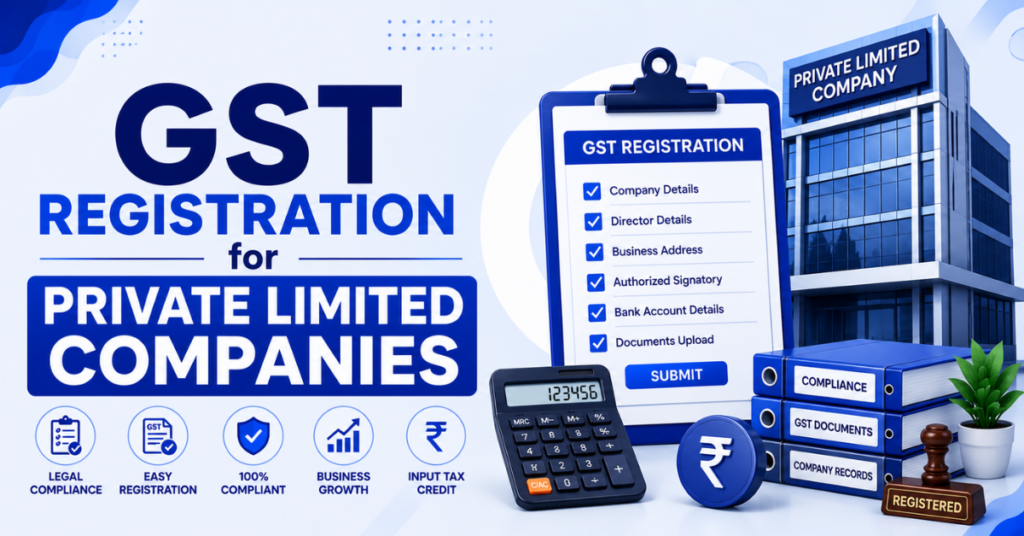
One of the key tax compliances for private limited companies in India is the GST registration. If a company is newly incorporated or already in operation, it is crucial to understand the requirements of GST to prevent compliance problems and for the smooth running of a business.
Click Here: Apply For GST Number
A private limited company gives it a legal identity, and it is a preferred choice for startups and growing businesses and investors. But the requirements for GST compliance are different from one business type to another. So company directors need to know when they should register for GST, what documents they will need, and the process of GST registration.
As more and more businesses are turning towards digital compliance systems, many are opting for an online GST registration procedure to make the process easy and adhere to the tax rules in time.
SSFintax Advisor is a reputable CA firm based in Delhi, India, that helps private limited companies enroll in GST, helps them file returns, and keeps them in compliance with the regulations.
Do private limited companies have to register for GST?
Comprehending the GST Registration Requirement
One of the common misconceptions is that all private limited companies are compelled to get registered for GST as soon as they are incorporated.
In fact, GST registration becomes compulsory in cases as per the provisions under the GST law, for example:
- Upon reaching the prescribed GST turnover limit for his/her business.
- If the company is engaged in interstate taxable supplies where the registration is required.
- In case the company comes under categories that have provisions for compulsory registration under GST.
- Where GST registration criteria have been applied when supplying via e-commerce platforms.
Businesses need to carefully consider the nature of their business activity and their turnover to decide upon their obligation to register.
GST Registration for Private Limited Companies has numerous advantages for businesses.
There are several advantages of private limited company GST registration.
Legal Tax Compliance
GST registration facilitates businesses to meet the Indian tax laws and adhere to the legal obligations.
Input Tax Credit (ITC) Benefits
The most significant benefit of GST registration is that it will allow businesses to avail themselves of input tax credits on their business expenses.
Examples may include:
- Office rent
- Professional services
- Business equipment
- Software subscriptions
- Marketing expenses
- The purchase of raw materials and inventory.
Eligible credits may lower the amount of tax due, depending on the rules and conditions applied to the GST.
Improved Business Credibility
The registration of a business under GST makes it more credible with
- Customers
- Vendors
- Investors
- Financial institutions
- Government departments
Increased business growth opportunities.
GST registration is a good thing, as it makes tax filing easier and invoicing simpler for many large organizations.
The following are the documents needed for online GST registration:
Company Documents
Private limited companies typically need the following:
- PAN of the Company
- Certificate of Incorporation
- Memorandum of Association (MOA)
- Articles of Association (AOA)
Director Documents
- PAN Card
- Aadhaar Card
- Photograph
- Contact details
Business Address Proof
Examples include:
- Electricity bill
- Rent agreement
- Property tax receipt
- Ownership documents
Bank Account Details
- Bank statement
- Cancelled check
- Bank account proof
Other documents may be necessary as per the business nature and requirements of the GST department.
To register for GST, the following steps should be taken:
The first step is to collect the required documents.
Always have all company and director documents available prior to beginning the application.
Step 2: Fill out the Online Application
GST registration can be done online on the official GST portal for businesses.
Step 3: GST verification by the GST authorities.
Submitted details and supporting documents are reviewed by the GST department.
Step 4: GSTIN Allotment
Once verified successfully, the company gets a GST Identification Number (GSTIN).
This will enable the business to issue GST-compliant invoices and fulfill obligations towards tax completion.
GST Compliance After Registration
Getting GST registration is just the first step.
GST Return Filing
Each registered business needs to submit appropriate GST returns in the prescribed time.
Tax Invoice Compliance
Companies are required to send their GST-compliant invoices.
Proper Record Maintenance
Businesses should ensure that they keep records of:
- Sales
- Purchases
- Tax payments
- Input Tax Credit
- GST returns
Reconciliation of Accounts
Conducting regular reconciliation helps to detect mismatches and minimize compliance risk.
Some of the most frequent errors in the registration of GST are as follows:
Incorrect Business Information
Inaccuracies in the name, PAN, address, or contact information could cause delays in the approval of the registration.
Uploading Incomplete Documents
The most frequent cause of delay is missing documents.
Selecting the wrong Business Activities
Mistaken classification of business activities can lead to compliance issues in the future.
Ignoring Post-Registration Compliance
Many businesses only register and do not pay attention to return filing and record keeping.
The reasons why online GST registration is preferred are mentioned below:
In today’s modern world, the process of GST is done mainly online.
Benefits include:
- Faster processing
- Paperless documentation
- Easy application tracking
- Improved transparency
- Convenient compliance management
This will make it convenient for businesses all over India to register for GST online without attending the government offices.
The role SSFintax Advisor can play.
With SSFintax Advisor, expert help for
- TDS Filing & Compliance, etc.
They have a team of experienced experts who assist startups, entrepreneurs, professionals, and small businesses to handle the registration process, tax obligations, compliance, and other related business needs efficiently.
SSFintax Advisor can help you with your online GST registration—we can help you with it.
Conclusion
For many private limited companies, GST registration is one of the compliance requirements that they must adhere to in India. By familiarizing themselves with the eligibility criteria for registration, preparing the necessary documents, filling out the application accurately, and ensuring continuous compliance, businesses can help prevent needless complications.
Treasury companies need to carefully review their GST obligations and ensure they meet their current GST obligations in order to facilitate smooth business operations and for future growth.
Frequently Asked Questions (FAQs)
1. Yes, all private limited companies are required to register for GST.
No. GST registration is applicable based on business activities, turnover, and other provisions of the GST. GST registration is not applicable in all cases.
2. Is the application for GST registration available online for a private limited company?
Yes. The process for applying for GST registration online involves companies submitting the necessary information and documents to the official GST portal.
3. What documents are to be submitted for GST registration?
Generally, the most common documents that are needed are PAN, Certificate of Incorporation, MOA, AOA, director KYC documents, address proof, and bank account details.
4. What is GSTIN?
The Goods and Services Tax Identification Number is a unique GSTIN issued by the GST system to registered taxpayers.
5. What happens if a business doesn’t register for GST?
Processing time is dependent on document verification and departmental review. The timelines are subject to change from case to case.
6. Is it possible to register a newly established business for GST?
Yes. Newly incorporated companies can apply for GST registration if they need to be registered by the provisions of the GST.
7. What will be the advantages of being registered under the Goods and Services Tax regime?
Advantages include legal compliance, input tax credit eligibility, business expansion opportunities, and credibility.
8. What will be the consequence if returns of GST are not filed?
Failure to file may lead to GST non-filing late fees, interest, notices, and other non-filing compliance issues.
9. When can a company avail of an input tax credit after GST registration?
Yes. Eligible registered taxpayers are entitled to claim input tax credit as per provisions and conditions of the GST.
10. What is the main purpose of SSFintax Advisor?
SSFintax Advisor will help with GST registration, GST return filing, accounting, compliance management, taxation, and other business registration services.